Slow Cooker Time Converter
Enter a time and food type to see the recommended conversion.
It is a question that haunts every home cook who has ever stared at their watch while dinner simmers in the background. You have three hours before you get home from work, but your recipe calls for eight hours on low. Do you just crank it up to high and cut the time in half? It seems like simple math, right? Two times four equals eight. But if you have ever tried this shortcut, you know the answer is rarely that clean. Sometimes the meat turns out tender and perfect. Other times, it is dry, tough, or barely cooked through.
The short answer is no, 4 hours on high is not exactly the same as 8 hours on low. While they reach similar internal temperatures eventually, the way the food gets there-and how the texture changes along the way-is completely different. Understanding this distinction isn't just about saving time; it is about understanding how heat transforms collagen, breaks down fibers, and keeps your food safe to eat.
The Physics of Heat: Why Time Matters More Than Temperature
To understand why swapping settings backfires, we need to look at what is actually happening inside that ceramic pot. A slow cooker does not cook food by boiling it rapidly like a pressure cooker or searing it like a pan. It cooks by maintaining a steady, gentle warmth over a long period. This process relies on two main factors: temperature and duration.
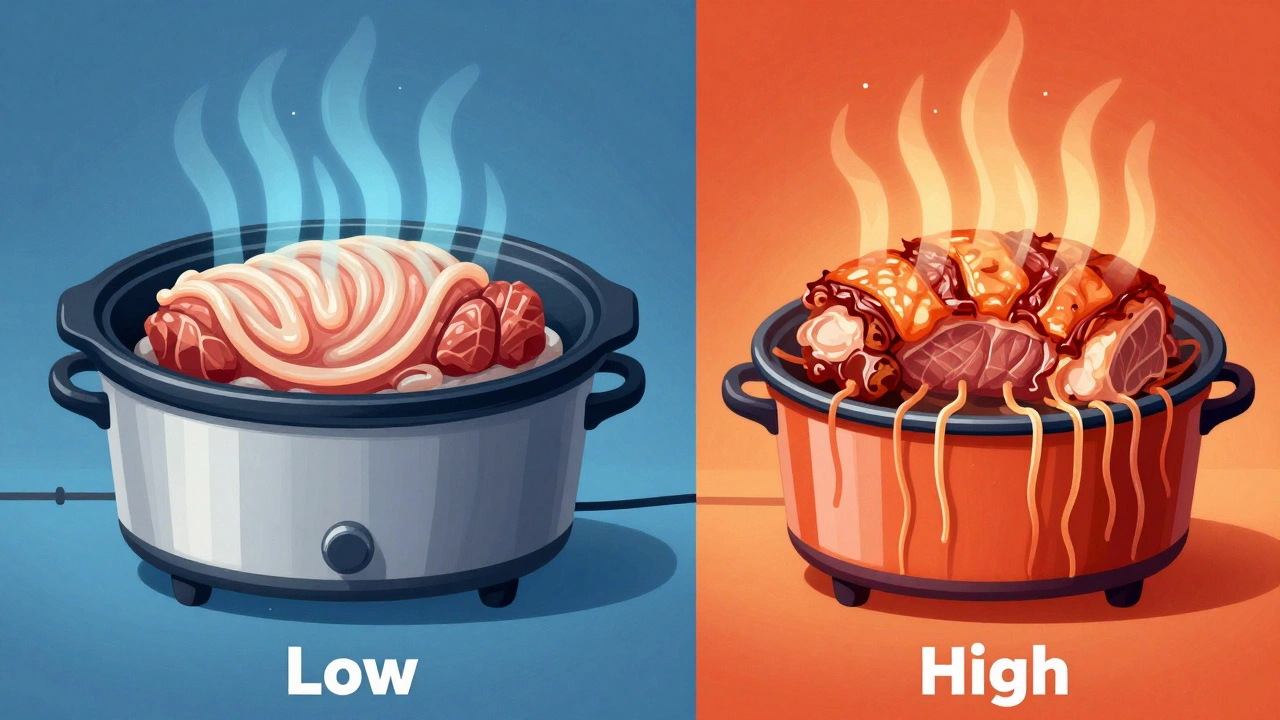
When you set your slow cooker to "Low," the heating element typically maintains a temperature around 190°F to 200°F (88°C to 93°C). On "High," it jumps to roughly 300°F (149°C). That sounds like a huge difference, but here is the catch: liquid in a pot cannot exceed its boiling point of 212°F (100°C) unless it is under pressure. So, even on High, your stew or chili is mostly sitting somewhere between 190°F and 205°F once the liquid starts simmering.
So, if the end temperature is similar, why does the time matter so much? It comes down to enzymatic breakdown and collagen conversion. Tough cuts of meat, like chuck roast or pork shoulder, are full of connective tissue called collagen. Collagen needs sustained heat to turn into gelatin, which makes meat juicy and tender. If you rush this process with high heat, you might raise the temperature fast enough to kill bacteria, but you don't give the collagen enough time to melt away properly. The result is often meat that is technically "cooked" but feels rubbery or stringy because the structure hasn't had time to relax and dissolve.
The General Rule of Thumb for Converting Times
Chef John from Food Network Kitchen and many other culinary experts suggest a rough guideline for converting recipes, but it is not a strict 1:2 ratio. A common rule of thumb is that one hour on High is approximately equal to two hours on Low. However, this only works well for certain types of dishes.
- For soups and stews: You can often convert 6-8 hours on Low to 3-4 hours on High. The vegetables will soften quickly, and the flavors will meld sufficiently.
- For large roasts: Be careful. An 8-hour brisket or pork shoulder on Low usually needs at least 5-6 hours on High, not just 4. The center takes longer to heat up, and rushing it can leave the middle undercooked while the outside dries out.
- For delicate proteins: Chicken breasts or fish fillets should almost never be cooked on High for extended periods. They dry out instantly. These are better suited for shorter Low cycles or finishing them in an oven.
If you are stuck and need to speed things up, it is safer to add 30 minutes to the converted time than to subtract it. For example, if a recipe says 8 hours on Low, try 4.5 to 5 hours on High rather than strictly 4 hours. This buffer allows the internal temperature to stabilize and the textures to develop properly.
What Happens When You Rush the Process?
Let's talk about the risks of hitting "High" when you should have stayed "Low." The most immediate danger is uneven cooking. Slow cookers are designed to distribute heat gently from the sides and bottom. On High, the heat source is more aggressive, which can create hot spots. Vegetables near the edge of the pot might disintegrate into mush while the chunks of meat in the center remain firm.
Texture is the biggest casualty of rushed slow cooking. Think about making beef bourguignon. The magic of this dish lies in the wine and herbs slowly penetrating the meat fibers over six to eight hours. If you blast it on High for four hours, the exterior of the meat tightens up due to rapid protein contraction, sealing in less flavor and preventing the sauce from fully permeating the dish. You end up with good-tasting broth and mediocre meat.
Another issue is evaporation. Even though slow cookers have lids, High settings generate more steam pressure. This can lead to slightly more liquid loss compared to Low. If your recipe relies on a specific consistency-like a thick chili or a creamy soup-you might find yourself needing to thicken it with cornstarch or flour slurry at the end because too much water evaporated during the intense heating phase.
Safety First: The Danger Zone
We cannot discuss slow cooking without addressing food safety. The USDA defines the "danger zone" as temperatures between 40°F and 140°F (4°C and 60°C), where bacteria multiply rapidly. Your slow cooker must bring food out of this zone quickly.
Here is where High actually has an advantage. Because it heats up faster, it moves food through the danger zone more quickly than Low. However, this only matters if you start with cold ingredients. If you put frozen meat directly into a slow cooker set to Low, it will sit in the danger zone for hours as it slowly thaws, creating a breeding ground for pathogens. Never cook frozen meat on Low unless your manufacturer specifically states it is safe for that model.
Conversely, if you are using High to save time, ensure you do not overload the pot. Crowding the cooker prevents heat circulation. If you pack ten pounds of meat into a six-quart pot and set it to High, the center will still take forever to heat up, negating the benefits of the higher setting. Always follow the "half-full to two-thirds full" rule for best results.
When Should You Stick to Low?
There are specific scenarios where switching to High is a bad idea, regardless of how busy you are. One major category is braising tough cuts of meat. Brisket, pork butt, and lamb shanks require long, slow exposure to heat to break down their dense connective tissues. These cuts benefit from the gradual temperature rise of the Low setting. The gentle heat allows the fat to render slowly and the collagen to transform into gelatin without squeezing the moisture out of the muscle fibers.
Dairy-based sauces are another red flag for High settings. If you are adding cream, cheese, or yogurt to your dish, doing so at the beginning of a High cycle can cause the dairy to curdle or separate. The agitation and high heat destabilize the emulsion. It is always better to add dairy in the last 30 minutes of cooking, ideally on Low, to keep it smooth and creamy.
Finally, consider the type of vegetable. Root vegetables like carrots and potatoes hold up well to long cooking times. Delicate vegetables like spinach, zucchini, or bell peppers will turn to slime if left on High for four hours. If your recipe includes a mix of hard and soft vegetables, sticking to Low gives you more control over the final texture, allowing you to add the delicate items later in the process.
| Feature | Low Setting | High Setting |
|---|---|---|
| Temperature Range | 190°F - 200°F (88°C - 93°C) | ~300°F (149°C) / Liquid boils at 212°F |
| Best For | Tough cuts of meat, all-day cooking, delicate textures | Quick meals, tender meats (chicken thighs), soups |
| Cooking Time Ratio | Baseline (e.g., 8 hours) | Roughly half the time (e.g., 4-5 hours) |
| Evaporation Rate | Minimal | Moderate to High |
| Collagen Breakdown | Gradual, thorough, tender | Faster, but risk of toughness if rushed |
Pro Tips for Mastering Your Slow Cooker
If you want to get the best results whether you are on High or Low, there are a few techniques that make a massive difference. First, always brown your meat before putting it in the slow cooker. Searing creates a Maillard reaction, which adds depth of flavor that boiling alone cannot achieve. This step is crucial because slow cooking essentially steams the food. Without that initial crust, your dish can taste bland.
Second, deglaze your browning pan with broth, wine, or vinegar. Scrape up those browned bits (fond) and pour the liquid into the slow cooker. This adds instant richness and complexity to your sauce. Since you are losing some evaporation control in a slow cooker, starting with concentrated flavor helps balance the final dish.
Third, pay attention to the shape of your ingredients. Cut meat and vegetables into uniform sizes. Large chunks of beef will take longer to cook than small cubes. If you mix sizes, you will end up with some pieces overcooked and others undercooked. Consistency ensures even heat distribution, which is especially important when you are trying to shorten the cooking time on High.
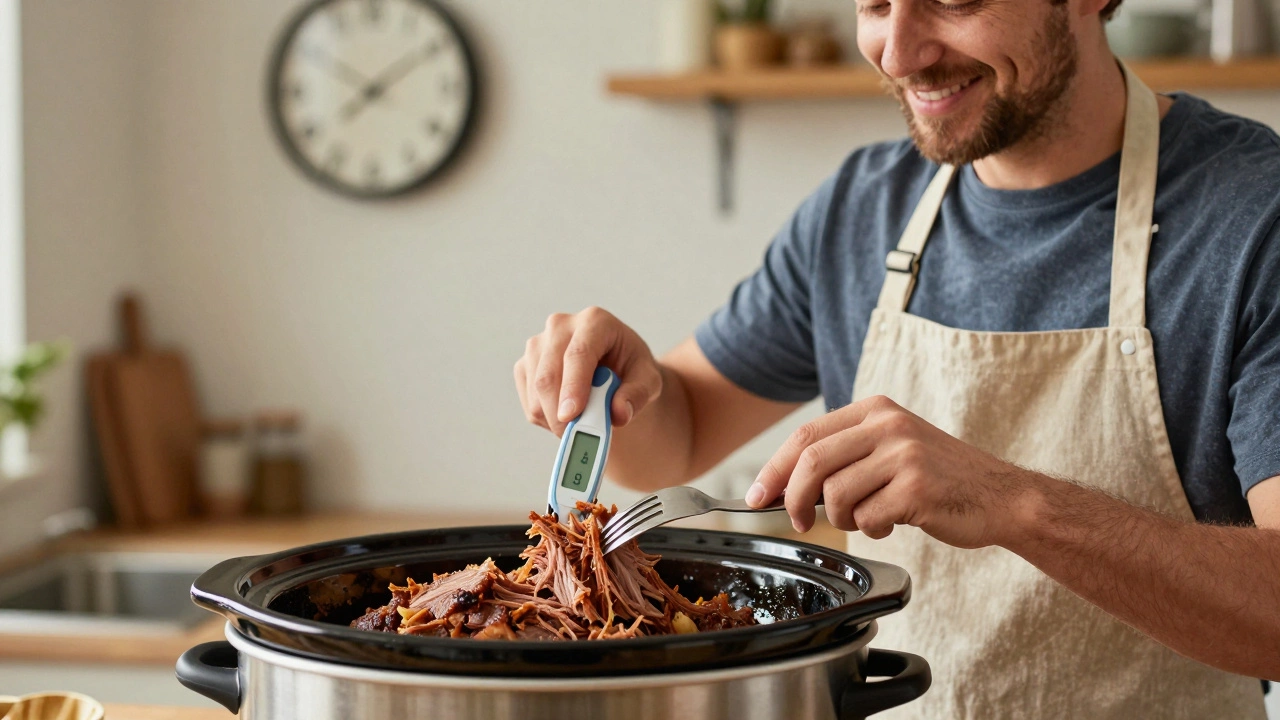
Lastly, use a meat thermometer. Don't guess. Insert the thermometer into the thickest part of the meat. For pulled pork or shredded chicken, you want to reach at least 195°F to 205°F internally to ensure the collagen has broken down. For whole chicken breasts, aim for 165°F. Knowing the exact temperature removes the guesswork from the "High vs. Low" debate.
Conclusion: Patience Pays Off
While it is tempting to treat the High setting as a turbo button for your dinner, it is really just a different tool for a different job. Four hours on High is not a perfect substitute for eight hours on Low. It is a compromise that works well for some dishes but fails for others. If you have the time, Low is almost always the superior choice for texture and flavor development. If you are short on time, High is a viable option, provided you adjust your expectations, monitor the liquid levels, and perhaps add a little extra time to ensure tenderness.
The beauty of slow cooking is that it fits into your life, not the other way around. Whether you choose to let your pot simmer gently all day or blast it for a quick evening meal, understanding these mechanics ensures you never serve a dry, disappointing dinner again. Next time you check the clock, remember: heat is energy, but time is the ingredient that truly transforms raw ingredients into comfort food.
Can I switch from Low to High halfway through cooking?
Yes, you can switch from Low to High, but it is generally not recommended to switch from High to Low. If you start on Low and realize you are running late, switching to High for the last hour or two can help finish the cooking process without ruining the texture. However, starting on High and switching to Low can leave the food in the danger zone for too long as the temperature drops, potentially creating a food safety risk.
Does leaving the lid open affect the cooking time?
Absolutely. Every time you lift the lid, you lose significant heat. It can take 20 minutes or more for the slow cooker to regain its target temperature. If you frequently check your food or leave the lid ajar, you will need to add substantial time to your cooking schedule, regardless of whether you are on High or Low.
Is it safe to cook frozen meat in a slow cooker?
Generally, no. Cooking frozen meat in a slow cooker, especially on Low, keeps the food in the bacterial danger zone for too long as it thaws. Most manufacturers and food safety agencies recommend thawing meat in the refrigerator before slow cooking. Some newer models are designed to handle frozen meat on High, but you must check your specific manual.
Why did my meat turn out tough after cooking on High?
Toughness usually occurs because the collagen didn't have enough time to break down into gelatin. High heat raises the temperature quickly, causing muscle proteins to contract and squeeze out moisture before the connective tissue can soften. To fix this, cook tougher cuts on Low for longer periods, or ensure you cook on High long enough (often 5+ hours for large roasts) to allow for proper breakdown.
Can I use a slow cooker on High overnight?
Most modern slow cookers have automatic shut-off features or switch to "Warm" mode after a set time, but relying on this is risky. Cooking on High for 8+ hours can lead to overcooked, dry food and potential safety hazards if the appliance overheats. It is best to use Low for overnight cooking or use a programmable slow cooker that adjusts automatically.